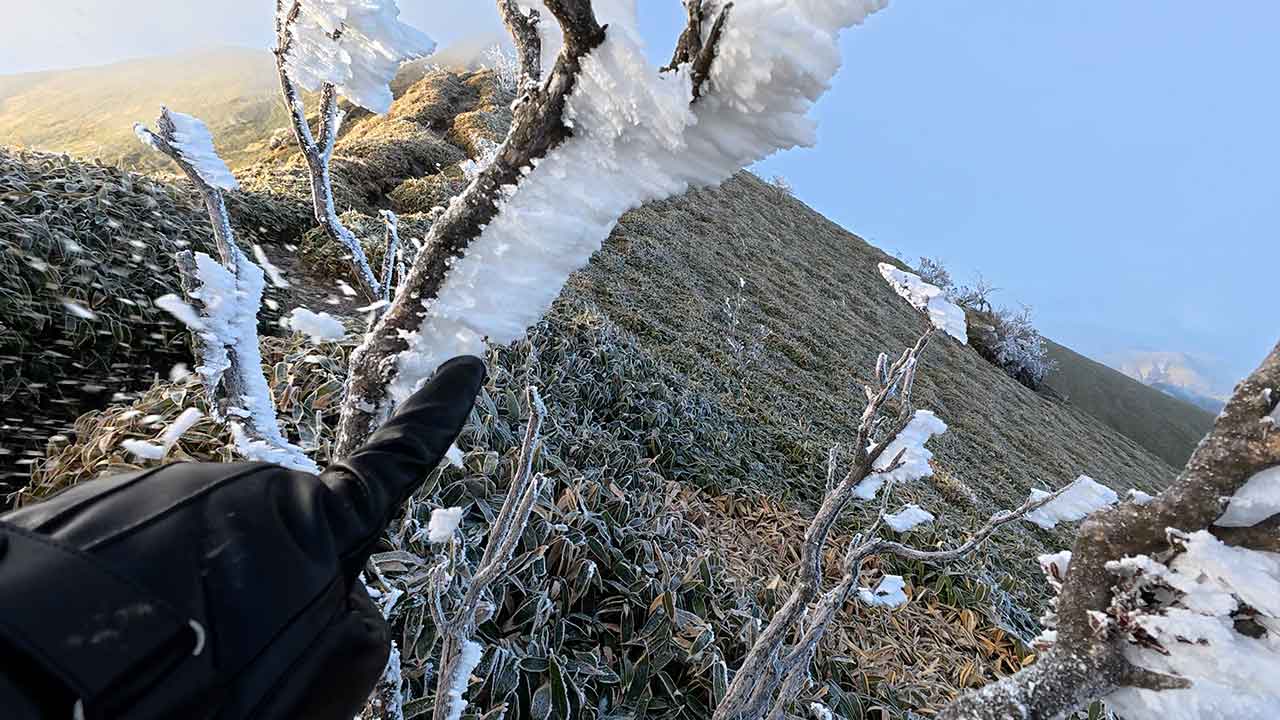
As winter approaches, rime ice, a rare sight only visible when specific conditions are met, appears on the summit of Mount Tsurugi (also known as Mount Tsurugi)
you can't just rely on luck to encounter this rime ice
It won't show itself unless the temperature, humidity, wind, and weather all align perfectly.
This time, Iused Windy.com and ChatGPT to predict the "lucky days" for frost formation, and Ihad the experience of actually being accurate in my predictions.
This article will explain in detail:
"How did we determine when rime ice would appear?"
find
opportunities to see rime ice on Windy?", and
"What was the climbing like on that day?"
Finally, the article touches on a topic that readers may be curious about: "Were there any bears?"
- What is frost?
- Predicting the possibility of rime ice with Windy and ChatGPT
- Departing at 2:30am. A complete night hike.
- And then──the frost really "existed"
- Video from the day (DJI Osmo Action5 Pro, audio intact)
- By the way, were there any bears?
- On the way home, I realized "Why there are so few bears in Shikoku"
- Summary: Rime can be "predicted"
What is frost?
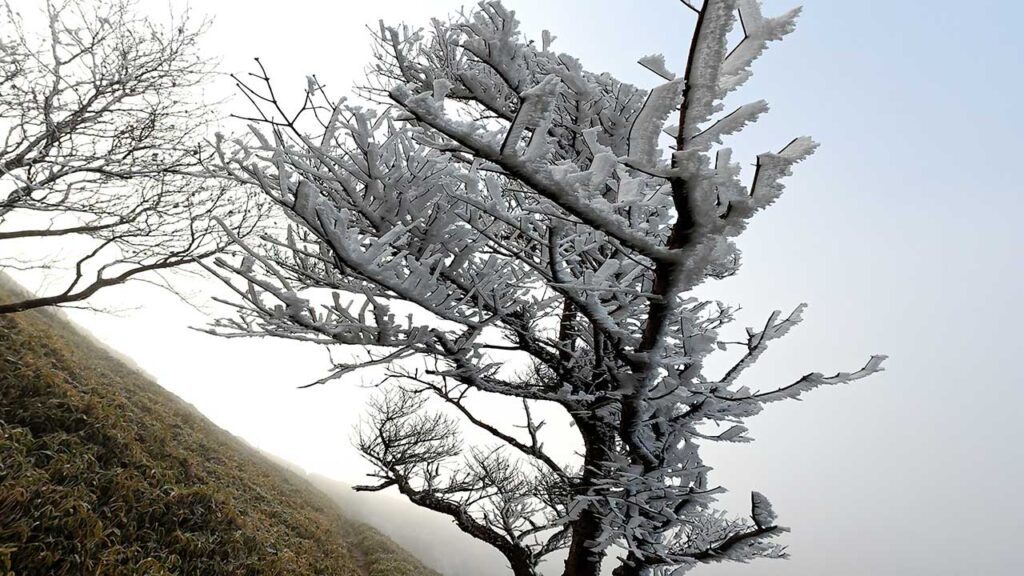
Rime ice isa phenomenon where supercooled water droplets in the air (which remain liquid even below 0°C) freeze instantly upon contact with tree branches or other surfaces. It's
a beautiful natural phenomenon unique to winter mountains, shining white as if covered in powdered sugar.
The conditions for its appearance are surprisingly strict.
- Temperature: below 0°C (ideally -2°C to -5°C)
- High humidity: Fog is occurring
- Weak wind: Ice does not grow if the wind is strong.
If these three conditions are not met, frost will not appear.
Therefore, you won't be able to see it just by climbing on a "cold day."
Predicting the possibility of rime ice with Windy and ChatGPT
To ensure a successful frost photography this time, I checked the weather conditions at the summit of Mt. Tsurugi (altitude set to 2,000m) in detail on Windy.com the day before my climb.
Conditions as of November 20, 2025 (from Windy)
- Temperature: Around -2°C overnight
- Wind speed: 1-5 m/s (a gentle wind ideal for frost growth)
- After 7:00 AM → Clear sky mark (the frost glitters, making it ideal for photography)
After seeing the screenshot, ChatGPT responded with this:
"These conditions perfectly match those required for rime ice to form."
"If you climb early in the morning on the 20th, there's a very high chance you'll see rime ice."
Encouraged by this "prediction," we decided to set the date for the climb as November 20th.
Departing at 2:30am. A complete night hike.
We departed at 2:30 AM that day.
After a break at Lawson Sadamitsu store, we arrived at the trailhead a little after 5:00 AM.
There were a few cars parked there, butI was the only one out on a night hike.
The hiking trail was pitch black, and my only reliance was my headlamp.
I dug out an action camera light I'd bought on Amazon several years ago and left unused in storage and brought it with me. I used this light to illuminate the path as I climbed.
Along the way, we heard what sounded like deer calls several times.
We continued to ascend steadily, remaining vigilant and turning around at the slightest rustling of the grass.
And then──the frost really "existed"
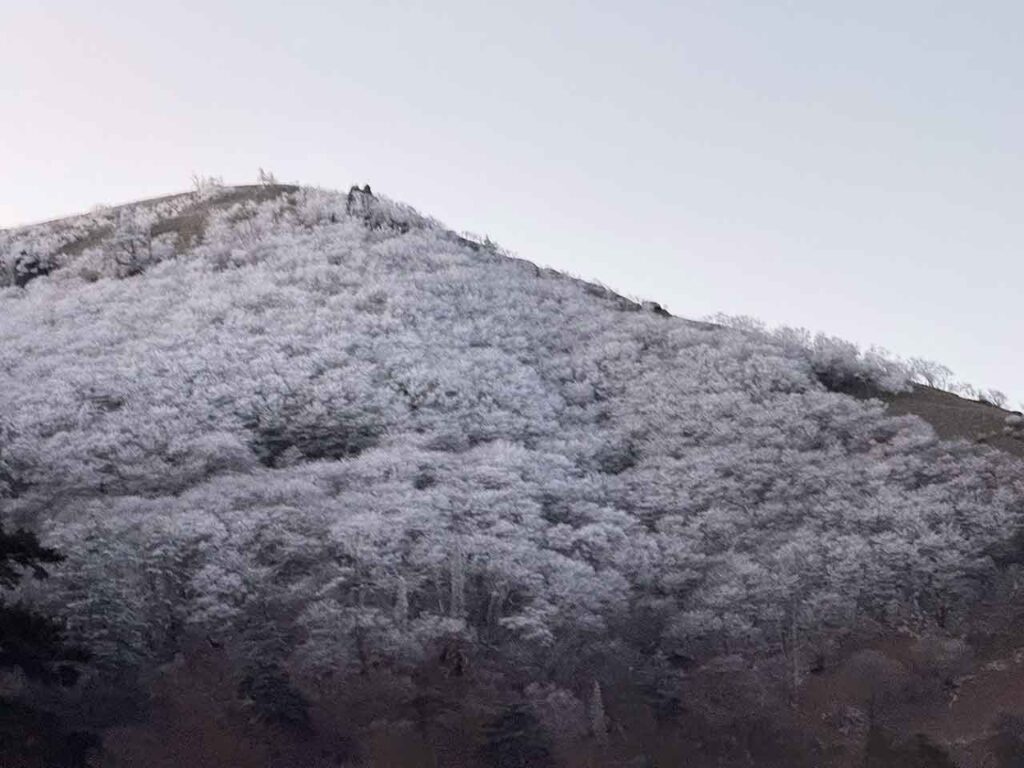
As the Nishijima Lift Station came into view, the surrounding area gradually became brighter.
Suddenly, I looked up towards the summit...
Only the trees near the summit of Mount Tsurugi were frozen white.
At that moment, I was convinced, "Yes, I did. This is frost."
Take a photo immediately and send it to ChatGPT,
"This is definitely frost!!"
When I heard this comment, I realized that Windy and GPT's weather analysis had been spot on.
Video from the day (DJI Osmo Action5 Pro, audio intact)
The beauty of the frost is difficult to convey in still images, so please be sure to watch the video.
The sound of the wind, footsteps, and the low temperature—the atmosphere of that day is perfectly captured.
By the way, were there any bears?
Conclusion:I didn't encounter any this time either.
The route I walked was
- Tsurugiyama trailhead → Nishijima Station
- Nishijima Station → Beginner Course
- To the observation deck overlooking Jirogui
- Continue walking along the ridgeline for a bit
I didn't encounter any other hikers on this route. And of course,I didn't see any bears either.
On the way home, I realized "Why there are so few bears in Shikoku"
On the way back, we took National Route 438 → National Route 492 → National Route 193 back to Kagawa.
In the village visible from the car window,all the persimmons on the trees remained perfectly intact.
In Honshu, there are constant reports of Asiatic black bears descending into human settlements due to food shortages and destroying fruit, but there is almost no evidence of this in Shikoku.
The reason is probably—
- The bear population in Shikoku is extremely low
- There may still be plenty of food left in the mountains
This is purely my personal observation, but I get the impression that the relationship between the mountains and bears in Shikoku is completely different from that in Honshu.
Summary: Rime can be "predicted"
This mountain climb made me realize that rime ice can be predicted to some extent by interpreting weather data, rather than relying solely on experience or intuition
Windy's temperature, humidity, wind,
ChatGPT condition analysis
, and actions taken on the day.
By combining these factors, we were able to successfully find a day when frost was most likely to form.
I hope this will be helpful for those who are aiming to photograph frost next year and beyond.
comment