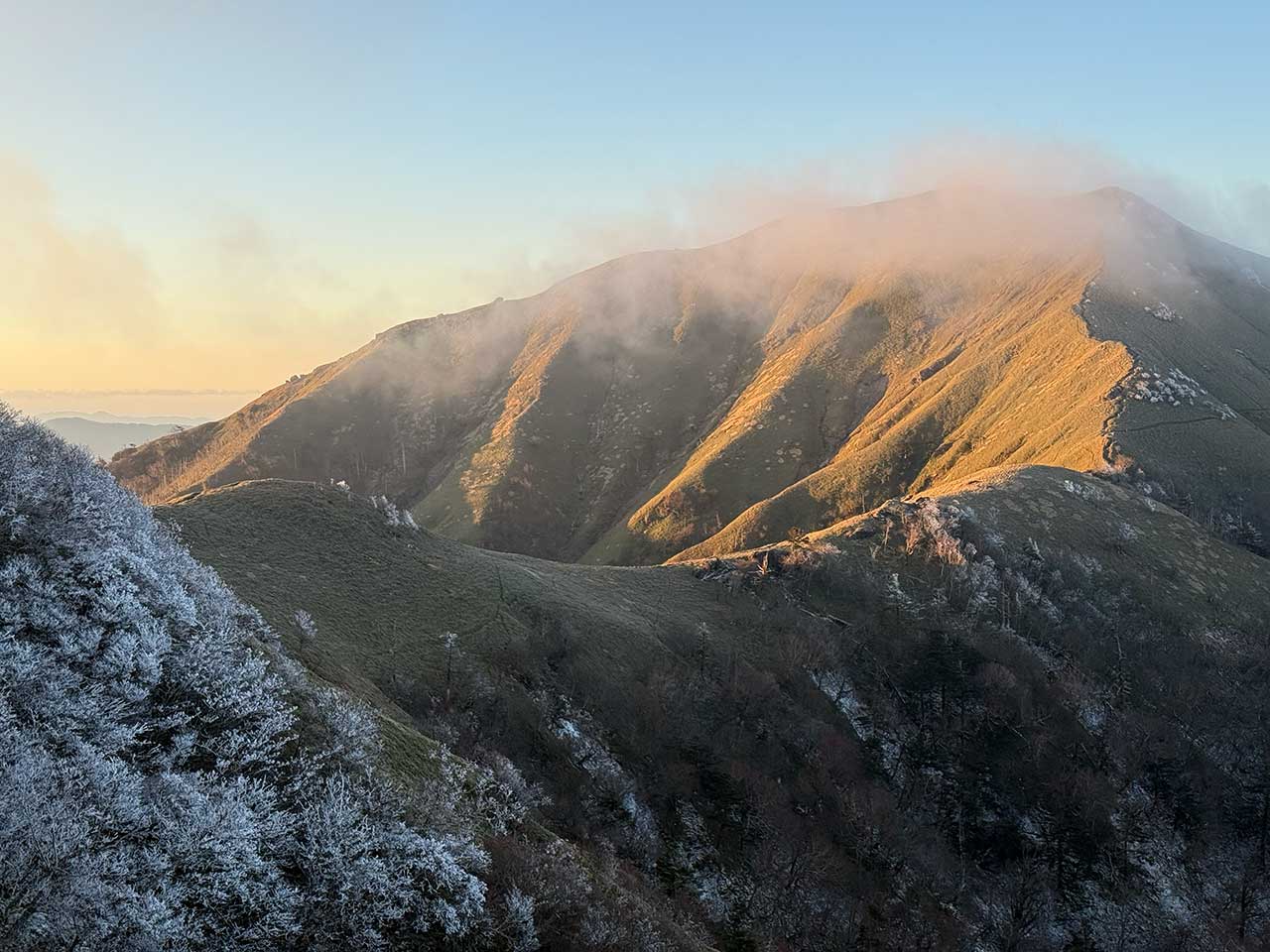
My previous article, "There are no bear attacks on people in Shikoku," has received a lot of traffic, and the number of clicks has continued to rise since the beginning of November. So this time, I've put together an updated report (Part 2) from my actual climb on November 20, 2025
There are two themes:
- ① Was it really possible to photograph frost on Mount Tsurugi?
- ②Have you had any interesting encounters with bears?
We will tell you everything, without holding anything back, about the charm of Mt. Tsurugi, the reality of mountain climbing, and the information that our readers are most interested in: bears.
Why did I decide to climb Mount Tsurugi again?
The reason is simple.
I wanted to film frost for a winter video for Setouchi Ambience.
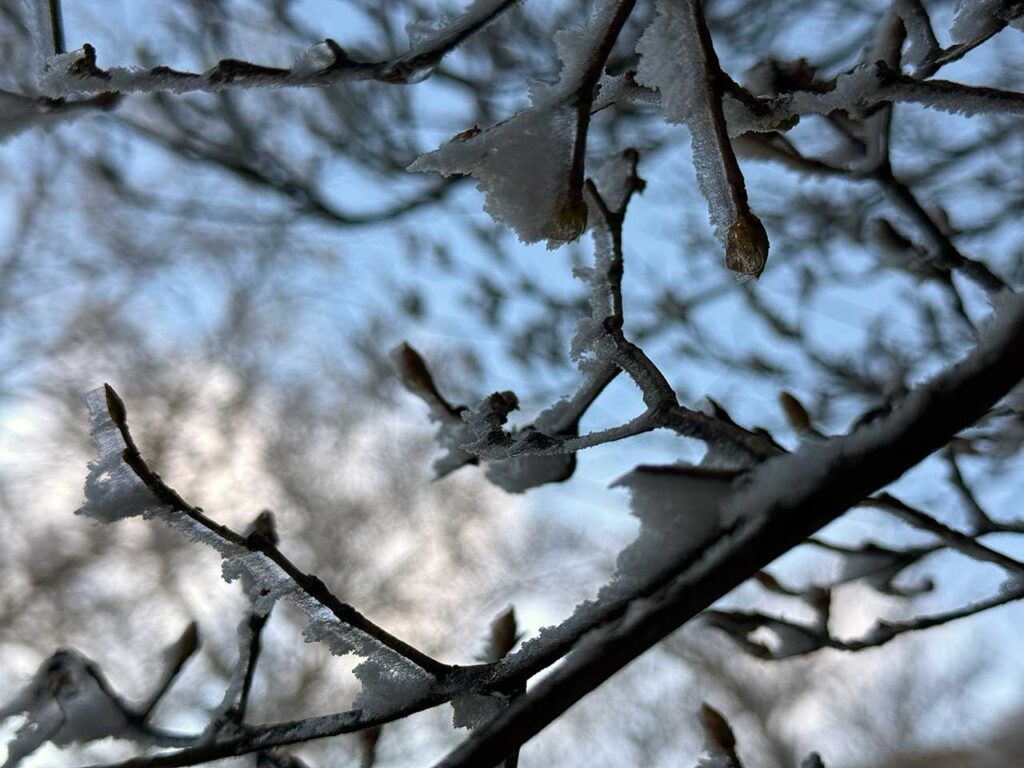
In winter, on Mt. Tsurugi, if the weather conditions are right, you can see "rime ice," where the trees are frozen solid and covered in a blanket of white.
However, seeing rime ice luck and timing . The conditions for its appearance are difficult to meet, and even locals rarely encounter it.
That's why I thought, "This is my chance," and decided to climb it again.
What is frost?
Hoarfrost is a phenomenon in which tiny ice particles (supercooled water droplets) adhere to tree branches and freeze.
Fog, wind, and low temperatures (usually below -2°C)
all come together to cause this phenomenon.
It looks pure white, but unlike snow, each grain reflects light delicately, creating a fantastical landscape.
Under what conditions does frost appear? Days of "weather analysis" with GPT
To predict the formation of hoarfrost, I used windy.com (paid version).
What I was checking was:
- Temperature at an altitude of around 2,000m
- wind speed
- humidity
- Possibility of supercooling
And to interpret this weather, I spent several days conducting detailed analyses with ChatGPT.
Based on the predictions, it was determined that there is a high probability of hoarfrost formation on November 20, 2025
More details on this weather analysis will be provided in a separate article at a later date.

Departing at 2:30 AM: The reality of the Mount Tsurugi night hike
Since rime ice is "most beautiful around sunrise," I left my home in Kagawa at 2:30 a.m. I took a break at the Lawson Sadamitsu store and arrived at the trailhead a little after 5 a.m.
However...
although there were a few cars at the trailhead, no one was walking before dawn.
It's a perfect night hike.
Luckily, I dug out an old action camera light I bought in storage and brought it with me.
Without it, it would have been completely dark.
- I turn around every time the shadows of the trees sway
- A deer-like cry echoes several times.
- Even a crosswind can be a shock
However, I am used to going into the forest alone, so although I was scared, I climbed calmly.
The frost finally appeared. I reported it to ChatGPT right away.
As Nishijima Station (the lift's final destination) came into view, the sky slowly began to brighten.
And then, when I suddenly looked up...
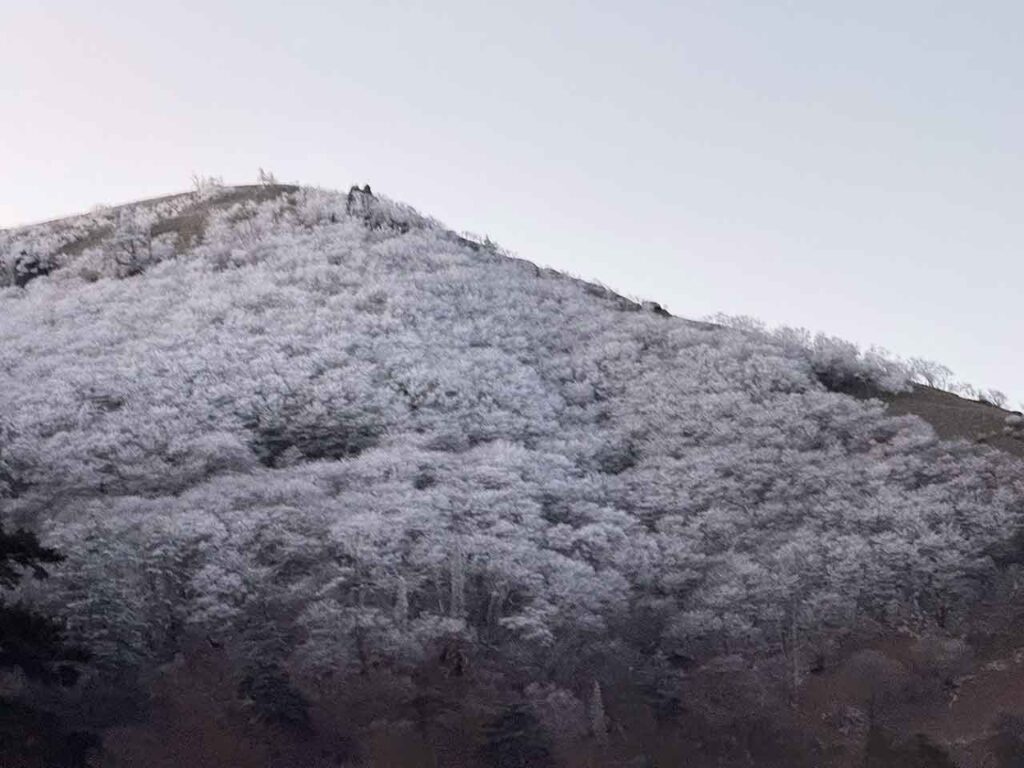
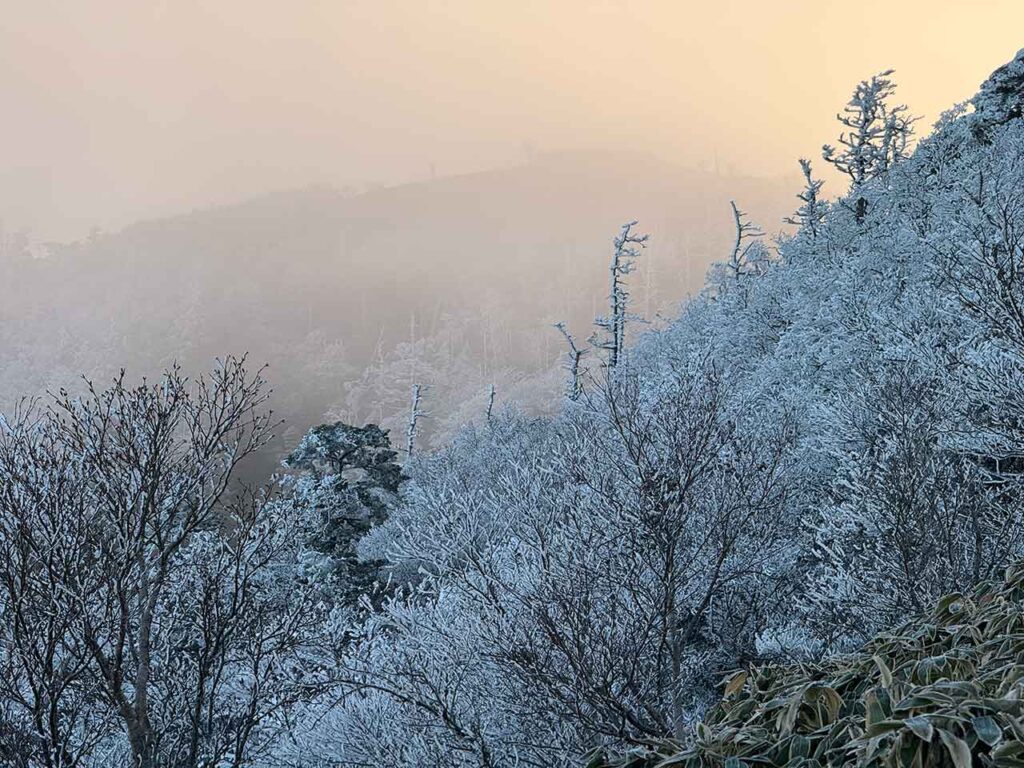
Only the trees on the summit of Mount Tsurugi shine bright white.
It was truly frost.
I immediately took a picture with my iPhone and sent it to ChatGPT.
The response I received was:
"That's definitely frost!"
A powerful reply.
At that moment, I truly felt glad that I came to Mount Tsurugi today.
So what about encounters with bears?
Don't worry.We didn't encounter any bears this time either.
However, I will make a note of the important points.
- A small number of Asiatic black bears live around Mount Tsurugi.
- Unlike Honshu, Shikoku has an overwhelmingly small population.
- The probability of encountering them is lower than in Honshu, but "it's not zero"
This time I walked the following route:
- Tsurugiyama trailhead → Nishijima Station
- Nishijima Station → Beginner's Course
- Arrived at the observation deck with a view of Jirogui
- Continue walking along the ridge towards Jirogui
I didn't encounter anyone in this section, probably because it was early in the morning . Naturally, I didn't see any bears either.
However, because I was so focused on filming the video, I honestly think my vigilance towards bears was lower than usual.
(I should have been more vigilant, though.)
A question I had on my way home: What about the bears in Shikoku?
After descending the mountain, we returned home to Kagawa Prefecture via National Highways 438 → 492 → 193.
Along the way, I saw many interesting sights.
The persimmon trees in every village still have their fruit intact.
In Honshu, there have been many reports of bears descending into populated areas due to food shortages in the mountains and "devouring all the persimmons," causing significant damage
However, in the mountainous area of Shikoku where I drove today...
All the persimmon trees still have their fruit in good condition.
From this, my personal thoughts are:
[Hypothesis] Do the bears of Shikoku still have enough food in the mountains?
- The bear population in Shikoku is originally small.
- The flow of food shortages → people coming down to the villages is not as common in Honshu as it was in the mainland.
- As a result, there may be less damage in the villages.
This is purely my personal opinion, but during today's hike, I got the strong impression that "the mountains of Shikoku don't pose as much of a bear threat as those on Honshu."
(Of course, this doesn't mean you can let your guard down!)
Summary: I was able to take photos of the frost. I didn't encounter any bears and was able to descend the mountain safely.
What I learned from this climb:
- ✔ Successfully photographed frost
- ✔ Mount Tsurugi at dawn is fantastic
- ✔ No bear encounters (no sign of bears)
- ✔ I gained new insights into the bear situation in Shikoku
The article on "Tsurugiyama Mt. Rime Ice" can be found here.

comment