Recently, I started a subscription to the New York Times. Despite the reasonable price of 300 yen per month, to be honest, I barely got to read it for a while. I felt like I was satisfied with just buying it, and that there was no point in it, and yet the notifications just kept arriving on my iPhone every day. That was the situation I found myself in
However, one day it suddenly occurred to me:
"If I feed this NYT article into ChatGPT, wouldn't it be possible to translate and summarize it all at once?"
At that moment, something connected within me
When I tried it, it was more comfortable than I imagined
- Choose an article that interests you in the NYT app
- Send the article URL to your MacBook
- Open it in Safari, switch to "Reader View" and copy only the text
- Paste it into ChatGPT and it will sort the contents in a few seconds
Perhaps there are other Japanese people out there who have already tried the same method. Butthe experience of being able to "instantly understand" the world's most cutting-edge news for a monthly subscription fee of 300 yen was quite a shock to me.
I used to be intimidated by reading difficult English articles, but with just one simple trick, I was able to keep up with global events on a daily basis.
This realization also ties into the direction of the blog I will be writing from now on. Starting with world news, I will focus on "Japan's current state" and "the local Setouchi region." I would like to start this new way of reading with this article
- The forefront of autonomous driving, AI, and infrastructure around the world
- What this reveals about Japan's current state
- Shipping: An Unexplored Continent
- The future as seen through the International Ryobi Ferry "Olympia Dream Seto"
- From local to global: Setouchi could be a test bed
- The NYT, which costs 300 yen a month, unexpectedly revealed the future of the Seto Inland Sea
The forefront of autonomous driving, AI, and infrastructure around the world
As I skim through the NYT daily, I naturally get a sense of where the world is heading, like statistics. One article I read recently was particularly striking
In China, the practical application of self-driving taxis is progressing rapidly, data centers face a massive demand for batteries to support AI, and the lines between military and technology are almost blurring.
In Silicon Valley in the United States, a battle for power infrastructure is underway, and the competition among AI companies is shifting from "computational power" to "electricity."
In other words,
the world is beginning to draw a new industrial map centered on "hardware," "energy," and "automation."
The more I follow the news, the more I am amazed at how quickly it happens
What this reveals about Japan's current state
Here, I feel simple,
Where does Japan stand on this map?
This is my question
Regarding autonomous driving, regulations and accountability remain unclear, and little progress has been made beyond the pilot testing stage.
The amount of investment in AI infrastructure is also orders of magnitude smaller compared to the United States and China.
Of course, it's not that Japan lacks technical capabilities.
However,now that the world has entered the "real thing,"I get the strong impression that Japan is still in the "preparation" stage.
The era when Japanese cars dominated the world is now a thing of the past.
The ability to create "unbreakable cars" is impressive, but that alone is not enough to change the course of the world.
So where should Japan compete?
Shipping: An Unexplored Continent
Here, we arrive at a hypothesis
Shouldn't Japan compete with ships instead of cars?
Japan is a country surrounded by the sea, possessing some of the world's leading ports and shipping routes, and inherently has the qualities of a maritime nation.
And above all, unlike cars
, ships are slow
, have fewer obstacles
, and can move in a wide open space
, making automation overwhelmingly easier to implement.
In fact, China is rapidly developing its land transportation infrastructure, while Japan is said to be strong in the field of automated maritime navigation
Inland seas like the Seto Inland Sea, in particular, are unanimously described by experts as "one of the most suitable areas in the world for the social implementation of autonomous navigation."
The future as seen through the International Ryobi Ferry "Olympia Dream Seto"
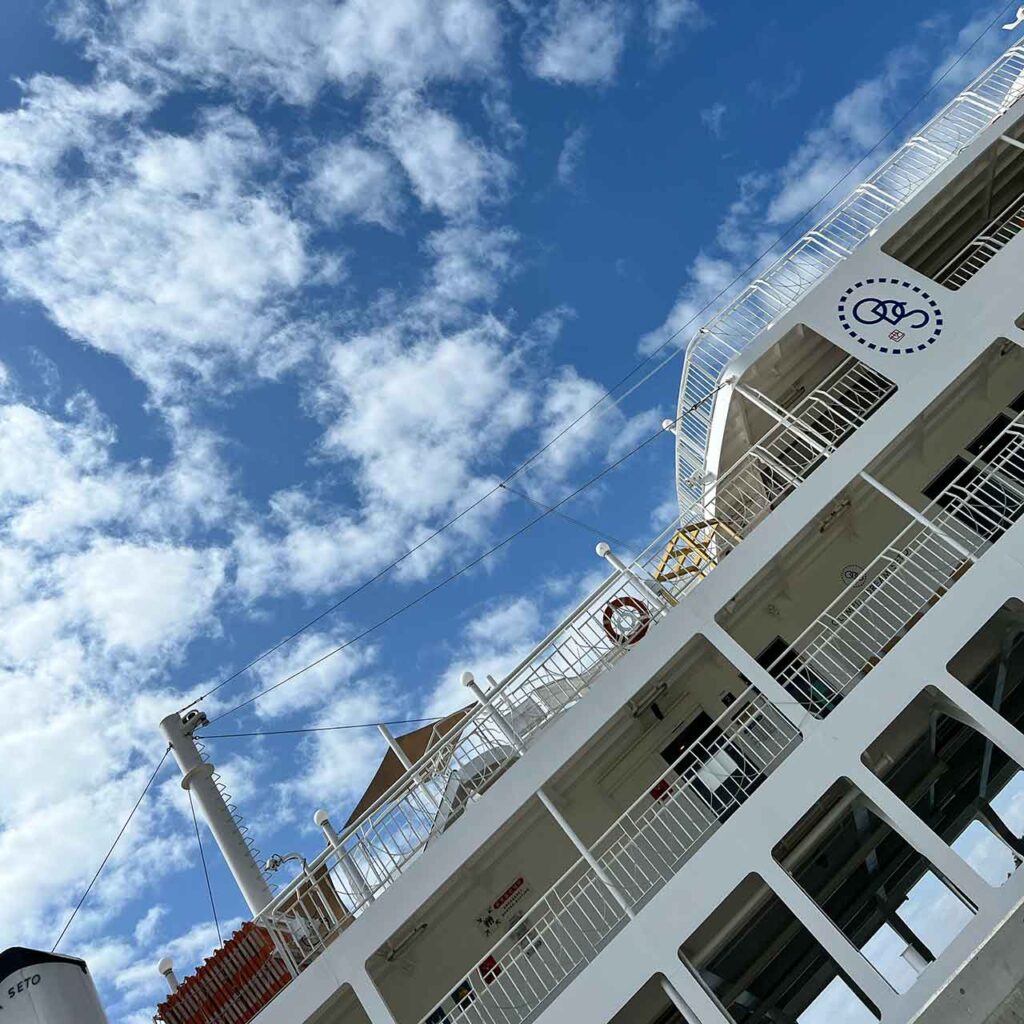
A prime example of this is the "Olympia Dream Seto," an automated ferry operated by Ryobi International Ferry .
A new trend, autonomous ferries, is now gaining momentum in the Seto Inland Sea. This month, Ryobi International Ferry's "Olympia Dream Seto" passed inspections for autonomous operation, becoming the world's first ship capable of commercial operation with "Level 4 autonomous driving equivalent."
The underlying reasons are the worsening population decline and shortage of seafarers throughout Japan.
In particular, the ferry routes to the remote islands in the Seto Inland Sea are vital for daily life and a major artery for tourism, so the question of "can we maintain the number of services?" is unavoidable.
Automation could be a concrete answer to this concern.
However, the Seto Inland Sea has complex currents and is home to many fishing boats and pleasure boats, making it a very challenging environment for autonomous navigation. That is precisely why its practical application here is of great significance. Mr. Unno, Executive Director of the Nippon Foundation, points out that more than 80% of ship accidents are due to human error and emphasizes that automation will also lead to improved safety
If automated navigation is established in the challenging Seto Inland Sea, it could serve as a model that can be expanded to other island routes in other regions.
This is not just a matter of technology; it can be said to be the beginning of creating a new infrastructure that protects the lives and transportation of people on remote islands.
From local to global: Setouchi could be a test bed
In the vast global situation depicted by the NYT, I began to think that the small region of the Seto Inland Sea might actually have an important meaning
- The population is small, but the shipping routes are stable
- The climate is relatively mild
- There are many islands, and there is a high demand for short-distance travel
- It is also a global art hub (Naoshima and Teshima)
There are few places better suited to making autonomous ferries a part of everyday life than here
It wouldn't be surprising if , in the future, people say, "The Setouchi autonomous ferry is a role model for the world."
The NYT, which costs 300 yen a month, unexpectedly revealed the future of the Seto Inland Sea
Following global news reveals Japan's weaknesses, but at the same time, it also reveals its potential.
This recent realization was a perfect example of that.
of the NYT, which costs 300 yen per month to subscribe to, and ChatGPT's summarization function,
surprisingly vividly brought to life the future of the Setouchi region.
comment